
ISSUE #140
BEAM FROM THE BOOTH | GRAND RAPIDS FILM SOCIETY
[EDITED BY: SPENCER EVERHART & GRIFFIN SHERIDAN]
Welcome back to BEAM FROM THE BOOTH, the official newsletter of the GRAND RAPIDS FILM SOCIETY!
May the Fourth be with you, friends. A reminder to all those who will be celebrating with us later TONIGHT: our SOLD OUT screening of STAR WARS: RETURN OF THE JEDI starts at 8:00pm, with doors opening at 7:00pm. We encourage you to arrive early, not just to ensure you and your party get the snacks and seats you want, but also so you don’t miss out on the COSTUME CONTEST we’ll be hosting before the film starts as well! It’s going to be a fun evening as we reach the thrilling conclusion of our journey through the Star Wars original trilogy, and we can’t wait to see you all there.

And now, we’re excited to showcase the return of our ongoing “Production Parables” column — focusing on the processes of filmmaking and cinematic art-making (stories, experiences, advice, insights, and everything in-between) — with this week’s incredible piece by new contributor Ellery Bryan. Please enjoy their feature essay below.

PRODUCTION PARABLES
ON CURIOSITY
[BY: ELLERY BRYAN]
Your curiosity is a function of your spirit that can sustain the entire cycle of your life if you let it. Curiosity is a skill you can build. You can learn how to look and begin to notice everywhere. This is the defining feature of people who think like artists — activating the operation of sight and inventing a logic of significance that applies to every mundane scene of one’s life. It can come alive on your daily commute or on a bad date. Curiosity has no investment in providing ultimate closure and has the capacity to synthesize all of the moving parts that came before it. It is democratic and dynamic. Most importantly, it is yours — a conversation you are in with yourself and your environment.
There is a hegemonic push for legibility that waters down vital intimate dialectics. A demand for a story to make sense to a broad consumer base in order to justify the resources it takes to make it necessarily dissolves some exactitude in its applications for a given ingroup. You are not for everybody and neither should be your artwork. This would be a bad sign. A single political party cannot possibly represent both the interests of the working and the owning classes. Artwork that transgresses and speaks from its own voice will lose something in translation to people who cannot identify its contents. This may acquaint you with what seems at first blush like failure or obscurity. It is unspeakably worthwhile to spend your life sinking effort into your insular world, populated as it may be by one or two or three friends. Maybe your friends have friends who also need them. This is how a network becomes buoyed through global crisis to engage with broader collective meaning and allows us to be brave. The innate value of your singular connections is not too small to legitimize your every effort. It is crucial for the survival of all marginalized people to see their experiences validated by enriching representation, provided that is not where our labor ends. My experience is not your experience. We might need different or overlapping voices to sustain us. We both deserve to be here.
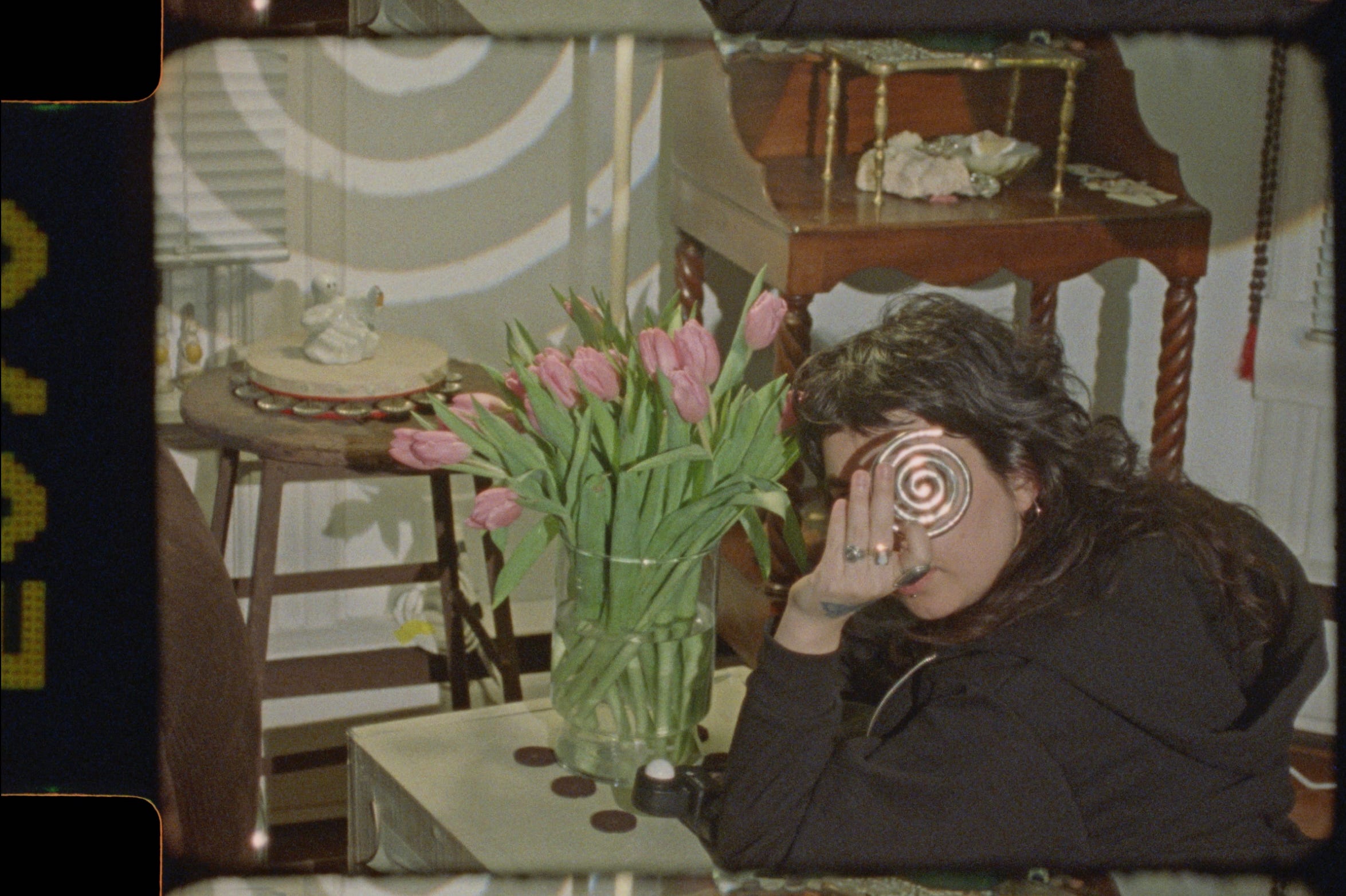
Here is how I would describe my creative practice: I consume as much fine art and written theory about human experience as I have the time for. Frequently, people in my life provide some direction through suggestions or their own artworks that I find inspiring. If I am stuck, I am not looking at enough work. I gravitate toward themes that I find significant and related to autobiographical phenomena: language, memory, loss, desire. I join those concepts with physical objects that act as symbols, and I surround myself with them in all of the common spaces that I inhabit. I fill rooms with materials that compose easily into footage of still lives and recorded interactions, and I let time and light and inspiration work over weeks and months. I hang lenses in windows and buy color slides of volcanoes and use projectors as lamps. If I look at these passively all the time, eventually an idea will strike. I have to incorporate beauty into the texture of my life because it inspires me. I keep cameras on hand so that there is no excuse to put things off due to fatigue or discouragement. I remember that I will have no idea whether an image is good or usable until it is developed. This gives me some freedom to try things. I structure my life so that I can act upon realizations quickly which arise through a larger project of inspecting my own interests and reactions on a daily basis. Eventually I am able to synthesize these images and their underlying concepts into a film that has likely evolved entirely from whatever intention I initially possessed. A film about love becomes a film about how I perceive my relation to my life.
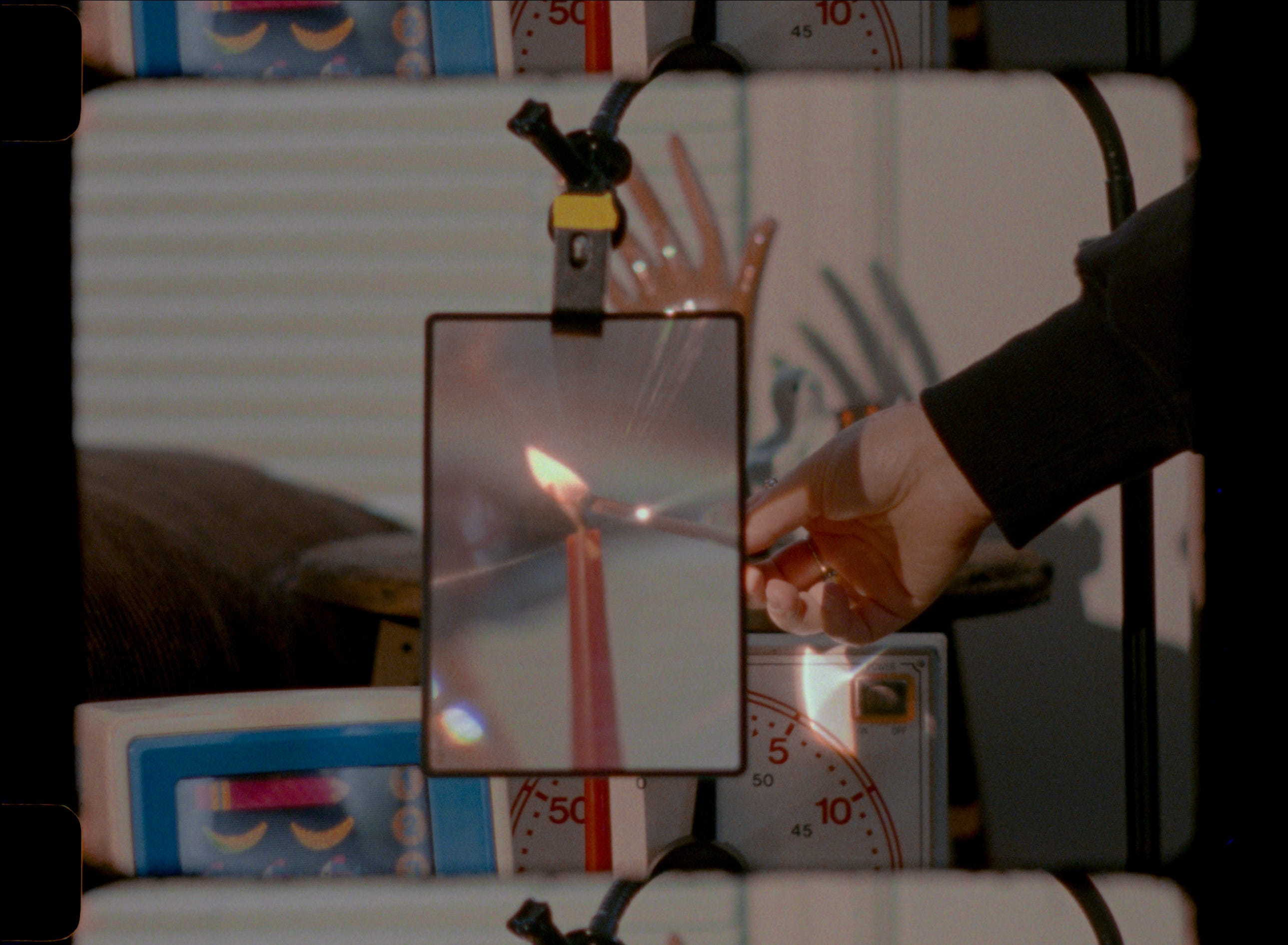
You should not be afraid to take your time to figure things out. When I make my films, I am often working in specified landscapes that I discover and return to over time and domestic spaces that are constantly shifting. Sometimes it takes looking at something for three seasons or three years to understand how objects, spaces, and my own body can gesture toward something that I have felt, considered, or experienced. I have been trying to record a compelling performance with an icicle since 2019, and I’m not sure I’ve done it yet. I might need a couple more years. I try to let it have its way with me.
Our lives take place in the theater of sensing and feeling. This is why it is swells of emotion that tie us to our defining moments. Artwork’s affective nature is what makes it indispensable to human experience. Emotion encodes memory, which constructs meaning that becomes narrativized through language. All reason is hyper-personal, even if it calls upon others’ with the instrumentalization of ambiguity. You can only run your hands across the inside of your corner of the universe for as long as you are living. No matter how close we become, we will never see the inside of any other. Your conscious pursuit is worthwhile whether people remember what you made or whether you finish anything at all. Learning to think and feel with curiosity for the duration of your existence is the point, indifferent to outcome. You should regard the world around you with receptivity. You should have interests that drive you to figure things out using creative and critical means. Open-ended assignments should lead you to your internal compass. When you are not provided with prompts, your curiosity should guide your process for you. You should build a language only you know so that you never run out of things to discuss with the earth. You can think of this as research.

We appreciate you taking the time to read this installment of BEAM and truly hope you’ll continue to do so. Be sure to subscribe to get a new issue in your inbox every week.
Plus, join us on social media, where the conversation is always happening, and you can get the most immediate updates from GRFS.
Know someone you think will dig BEAM FROM THE BOOTH? Send them our way!
And if YOU would like to contribute a piece to an upcoming issue, we highly encourage you to send us an inquiry.
Look for ISSUE #141 in your inbox NEXT WEEK!
Until then, friends...

